
Animation is the rapid display of 2D or 3D images in sequence giving the watcher an optical illusion that makes inanimate object look as if it is animate. At the very beginning when animation was in its first stage it was a popular toy to children, in the present day animation is used in a variety of things like advertisement, children movies and TV shows.
The Thaumatrope
 Back in 1824 a man called Peter Mark Roget invented a simple device which was made of no more then a paper circle and some string, this was called the Thaumatrope. At the time the Thaumatrope was a popular and simple toy to use, the child would simply pull the string which was tied onto both sides of the paper circle wind it up a couple of times and then release making the paper circle spin. On the paper circle were two different pictures and when the paper circle is spinning the viewer would see both pictures together, giving the illusion that the two pictures were one using simple movement. This simple invention which uses movement to create illusion was the first in animation.
The Phenakistoscope
 As time past new ways to experiments animation were being developed and in 1830 two inventers, Joseph Plateau in Belgium, and Simon Stampfer in Austria both simultaneously the Phenakistoscope. The word Phenakistoscope meant: 'deceptive view'. The Phenakistoscope uses a cardboard disc with small slots around the edges this allow the viewer to see, on the other side of cardboard disc in between the slots where sequence drawings. When the viewer wanted to see the animation they would simply spin the cardboard disc on an axle in front of a mirror and watch the drawing move. The last phase of the movement joined up with the first phase, so the motion was repeated continually. Later versions had separate shutter disc and picture disc on the same spindle. The viewer looked through the slots in the revolving shutter at the sequence pictures: no mirror was necessary.
The Thaumatrope being the first animation was a simple design using a single picture on both sides of a paper disc. While the Phenakistoscope using a more complex design using a sequence of drawing to give a greater illusion of movement.
Zoetrope
 In 1867 an American, William Lincoln, invented a patented new way to watch animation. The Zoetrope is based on the same principle as the Phenakistoscope, but is cylindrical in shape. This enabled several people at the same time to view the moving pictures. A zoetropes has thirteen slots through the cylindrical side; inside of the cylindrical is a strip with 12 images which would produce the moving subject that appears to progress forwards.
 This newer design using a cylindrical shape enhanced viewing for many people as well as being hands free and in on uses of a mirror to watch the animation.
Flipper book
The first flip book appeared in September, 1868, when a man called John Barnes Linnett showed off is invention the Flip book. A flip book is a book with a series of pictures that vary gradually from one page to the next, so that when the pages are turned rapidly, the pictures appear to move by simulating motion or some other change. Flip books are essentially a primitive form of animation. Like motion pictures, a flip book relies on persistence of vision to create the illusion that continuous motion is being seen rather than a series of discontinuous images being exchanged in succession. The book must also be flipped with enough speed for the illusion to work, the way to watch the animation of the flip book is to hold the book with one hand and flip through the pages rapidly with the thumb of the other hand.

The flip book was one of the first types of animation that employed a linear sequence of images rather than circular (as in the older phenakistoscope). With this style of showing animation the flip book would give birth to cinema.
Stop motion
Stop-motion animation is a term used to describe animation created by physically manipulating real-world objects and photographing them one frame of film at a time to create an illusion of movement. There are many different types of stop-motion animation used, usually named after the type of media used to create the animation.
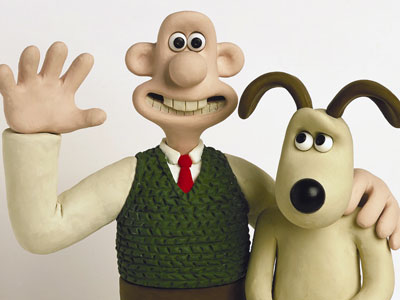 Clay animation or Claymation is the most commonly know type of stop motion used. What clay animation does is use figures made of clay or a similar malleable material to create a stop-motion animation. The figures used will sometime use an armature or wire frame, similar to the related puppet animation (below), which can be manipulated in order to pose the figures. Alternatively, the figures may be made entirely of clay, such as in the films of Bruce Bickford, where clay creatures morph into a variety of different shapes. Other examples of clay-animated works include Wallace and Gromit shorts (1989) and Curse of the Were-Rabbit (2008) and The Trap Door (1984).
  Puppet animation mostly involves stop-motion but uses puppet figures instead of clay. To keep the puppets still when doing stop motion the puppet has an armature inside of them to keep them still and steady as well as constraining them to move at particular joints. Good examples of stop motion which use a puppet for stop motion are a Nightmare before Christmas (1993), Corpse Bride (2005) and Coraline (2009).
Unlike their animated counterparts stop motion is watched on film after the animation is done, some stop motions can take up to a year to complete before being seen. To give the animation lifelike movement the animator must move the figure or puppet slightly, take a photo move the figure again and repeat until getting the full motion.
Cel animation
Cel animation or traditional animation as it is also known as is the most known, historically and most popular form of animation. On its first appearance it amazed watchers as its style of animation using the same technique as the flip book. Cel animation is made in stages the first is the storyboard, this is done in a series of pictures which have been draw to give the artist a more vivid description on what will be happening in the story. When the storyboard is in order the animators move onto the next stage: the animation. The animation movement is drawn frame by frame on a transparent panel which is placed over a background, just like the flip book the frames are placed on top of the background and then removed to place the next frame on top the background and so on until the scene is finished. While the animators is placing the frames onto the background the animator takes a photo of the picture from a high perspective, with this the animator chapters the frame by frame motion which will be come the animation. Because traditional animation is drawn frame by frame it can be very expensive and time-consuming process.

Rotoscoping is a method of traditional animation invented by Max Fleischer in 1915. Rotoscoping is when animation is "traced" over actual film footage of actors and scenery. Traditionally, the live action will be printed out frame by frame and registered. Another piece of paper is then placed over the live action printouts and the action is traced frame by frame using a lightbox. The end result still looks hand drawn but the motion will be remarkably lifelike. In most cases, rotoscoping is mainly used as a guide to aid the animation of realistically rendered human good examples of using rotoscoping are Snow White and the Seven Dwarfs, Sleeping Beauty and Anastasia.
This was a great improvement of 2D animation for not only did cel animation not need help from human manipulation to display the animation but allows the watcher a more lifelike motion to the animation. Apart from stop motion being the only other to using a camera to create an animation cel animation is easier to correct then stop motion for if an animator makes a mistake in stop motion the scene would have to be redone while in cel animation if the animator makes a mistake they would simply draw a new frame which fits with the scene.
CGI – 1990’s
Computer-generated imagery (also known as CGI) is the application of the field of computer graphics or, more specifically, 3D computer graphics to special effects in films, television programs, commercials, simulators and printed media. Video games usually use real-time computer graphics (rarely referred to as CGI), but may also include pre-rendered "cut scenes" and intro movies that would be typical CGI applications. These are sometimes referred to as FMV (Full motion video).
Apart from being used to make animation CGI is used for visual effects because computer generated effects are more controllable than other more physically based processes, such as constructing miniatures for effects shots or hiring extras for crowd scenes, and because it allows the creation of images that would not be feasible using any other technology. It can also allow a single artist to produce content without the use of actors, expensive set pieces, or props. Computer software such as 3ds Max, Maya and Autodesk Softimage is used to make computer-generated imagery for movies, etc. Recent availability of CGI software and increased computer speeds has allowed individual artists and small companies to produce professional grade films, games, and fine art from their home computers. CGI was first used in movies in 1973's Westworld but in the sequel movie it used 3D Wireframe imagery in, Futureworld (1976), which featured a computer-generated hand and face created by students Edwin Catmull and Fred Parke.

2D CGI increasingly appeared in traditionally animated films, where it supplemented the use of hand-illustrated cels. Its uses ranged from digital tweening motion between frames, to eye-catching quasi-3D effects, such as the ballroom scene in Beauty and the Beast. In 1995, the first fully computer-generated feature film came out, Disney-Pixar's Toy Story, was a resounding commercial success. In additional digital animation studios such as DNA Productions (Paramount Pictures and Warner Bros.) and Pacific Data Images (DreamWorks SKG) went into production, and existing animation companies, such as The Walt Disney Company, began to make a transition from traditional animation to CGI.
In the end CGI surpassed all the different styles of animation, because CGI uses computer software to make its animation it was cheaper to use to create animation the cel animation. Apart from being cheaper to produce CGI also give an animation a more realistic look to both the effect used and characters in the animation.


